
Non-banking financial companies (NBFCs) reported encouraging results for Q4FY26 with improved asset quality and earnings, but analysts maintain a cautious near-term outlook due to geopolitical tensions, monsoon risks, and specific portfolio concerns.

What is the reason behind this drying up of talent for the top post in private banks?

Discussion paper fixes Rs 1,000 cr as minimum capital for these specialised banks

The Reserve Bank of India's proposal to allow non-banking financial companies (NBFCs) access to the term money market is projected to significantly increase market volumes by 40-60 per cent in the first year, potentially doubling turnover within two to three years, according to treasury executives.

India's high cost of capital due to relatively shallow corporate bond markets, limited institutional investor depth, sovereign risk premia, and regulatory restrictions on capital flows, is a constraint on private investment and long-run growth, the Economic Survey, authored by Chief Economic Advisor (CEA) V Anantha Nageswaran, said.

The central bank is yet to consider actions such as a rate hike or mobilising dollar inflows from non-resident Indians to boost forex reserves as it cannot afford to continue with them for long when the rupee's internationalisation tops its agenda, explains Tamal Bandyopadhyay.

The most financially successful borrowers will not necessarily be those who have the easiest access to credit. They will be the ones who understand how to manage it wisely

India's privatisation push, once projected as a cornerstone of economic reform, has suffered another setback, with the Centre set to call off the IDBI Bank stake sale, highlighting the political and structural constraints shaping the country's disinvestment policy, experts say.

A government mandate requiring central public sector enterprises to use the Trade Receivables Discounting System (TReDS) for settling small business invoices is expected to significantly increase volumes on these platforms.

State Bank of India Chairman C S Setty has expressed support for a 'pause' in policy rates by the Reserve Bank of India's monetary policy committee, believing it will help stabilise conditions and support economic growth. He also urged investors to look beyond short-term equity market movements and focus on India's structural transformation, driven by reforms and digital infrastructure.

But selectively, with regulatory scrutiny and special approval, points out Tamal Bandyopadhyay.

Chief Economic Advisor V Anantha Nageswaran stated that India's economy is projected to return to a 7 per cent-plus growth trajectory by 2027-28 (FY28), or sooner if external conditions improve, despite near-term challenges from the West Asia crisis.

India's market regulator, Sebi, has approved the re-introduction of open-market share buybacks through stock exchanges, effective August 1, 2026, alongside easing debt listing norms for RBI-regulated entities and simplifying rules for mutual funds and alternative investment funds.

The liquidity deficit in the banking system crossed Rs 2 trillion again on Monday, despite the second instalment of cash reserve ratio (CRR) reduction coming into effect from December 28.

>It's not easy to predict the market. But there are at least two positive factors to back the PSU banks, explains Tamal Bandyopadhyay.

Payments banks have urged the Union finance ministry to increase their deposit limit for each account to Rs 5 lakh, according to a source who participated in a meeting, chaired by the Department of Financial Services Secretary M Nagaraju, in New Delhi. At present, they can accept deposits of up to Rs 2 lakh.

With rising credit demand, cleaner balance sheets, and renewed investor confidence, banks are positioned at the forefront of the market rally. From major players like ICICI and HDFC to broader policy shifts, there's much driving this momentum.
With rising credit demand, cleaner balance sheets, and renewed investor confidence, banks are positioned at the forefront of the market rally. From major players like ICICI and HDFC to broader policy shifts, there's much driving this momentum.
With rising credit demand, cleaner balance sheets, and renewed investor confidence, banks are positioned at the forefront of the market rally. From major players like ICICI and HDFC to broader policy shifts, there's much driving this momentum.

Investors should do thorough due diligence when selecting a platform.

The Confederation of Indian Industry (CII) has proposed a 20-point policy agenda to the finance ministry, including a conflict-linked emergency credit line guarantee scheme and tax rationalisation on energy inputs, to support MSMEs, exporters, and energy-intensive industries affected by the ongoing West Asia war.

The Reserve Bank has rejected applications of Flipkart co-founder Sachin Bansal-backed company Chaitanya India Fin Credit Private Limited, and five others for setting up banks as these were "not found" suitable, an official statement said on Tuesday. The RBI in a statement said the examination of six applications has now been completed as per the procedure laid down under the guidelines. "Based on the assessment of the applications, (six) applicants were not found suitable for granting of in-principle approval to set up banks," it said.

Indian stock markets are set to be influenced by ongoing developments in the US-Iran conflict, fluctuations in crude oil prices, and the latest quarterly earnings reports from major corporates, with foreign investor activity also playing a crucial role.

'Corporates now have multiple funding sources beyond banks, and many are sitting on large cash reserves.'

Besides, two new entities-- IDFC and Bandhan -- have been given full-fledged banking licence.

HDFC Bank on Tuesday said RBI has given approval to the group to acquire up to 9.5 per cent stake each in six lenders, including ICICI Bank and Axis Bank.

Bajaj Finance's shares fell more than 7 per cent on Tuesday after it trimmed growth guidance for FY26, from 24-25 per cent projected earlier to 22-23 per cent.

The Indian banking sector could be due for a rise in profitability after several quarters of net interest margin (NIM) compression. The Q2FY26 results suggest NIMs have bottomed out.

S&P Global Ratings warns that a sustained rise in crude oil prices to $130 per barrel could significantly slow India's economic growth, weaken fiscal metrics, and strain corporate and banking sector performance, potentially reducing growth by up to 80 basis points.

Deferred payment plans may come with a cost, which may not be immediately visible.

The upcoming Tata Sons board meeting in June could possibly throw some light on several critical issues that may have a bearing on the future of the corporate behemoth.

Leading non-banking financial company (NBFC) Shriram Finance on Friday said Japan-based MUFG Bank would invest Rs 39,618 crore, or $4.4 billion, to acquire a 20 per cent stake on a fully diluted basis through a preferential issue of equity shares.

'Credit growth in India remains in double digits, even though corporate borrowing is subdued.' 'Corporate credit is weak because companies are cash-rich and cautious amid global uncertainty.'
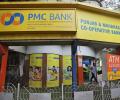
The Reserve Bank on Friday extended the regulatory restrictions on Punjab and Maharashtra Cooperative (PMC) Bank by another six months till December 2021 to enable the completion of its takeover by Centrum Financial Services. Paving the way for takeover of the crisis-ridden bank, the RBI had earlier in the month granted in-principle approval to Centrum Financial Services to set up a small finance bank (SFB). "Taking into account the time required for completion of various activities involved in the process...the validity of the ...Directive dated September 23, 2019, as modified from time to time, has been extended for a further period from July 1, 2021 to December 31, 2021, subject to review," the RBI said in a notification.

Ask rediffGURU Naveenn Kummar your insurance mutual fund and personal finance-related questions.

Commercial banks have turned cautious in lending to smaller microfinance institutions (MFIs), which has compelled the latter to borrow from non-banking financial companies (NBFCs) at much higher rates. Recently Reserve Bank of India (RBI) Deputy Governor M Rajeshwar Rao slammed micro lenders for increasing their margins "disproportionately" and said these lenders were quick to pass on the increased cost to the borrowers but reluctant to pass on the benefits under the new regime, where margins are not capped.

With duties at 15%, GST at 3%, and making charges running as high as 20% -- the gap between a smart purchase and a careless one can easily be Rs 30,000 to Rs 50,000 on every Rs 1 lakh invested. And most of that gap is entirely avoidable. Ramalingam Kalirajan explains the math.

Suitors for Punjab and Maharashtra Co-operative Bank (PMC Bank) may have to infuse additional capital of nearly Rs 750 crore so that the payout per depositor is more than the Rs 5 lakh sum assured by the Deposit Insurance and Credit Guarantee Corporation (DICGC). The Reserve Bank of India (RBI) has also slotted its board meeting on March 19 in Mumbai - a fortnight short of the current deadline to find a resolution for the beleaguered bank and the moratorium placed on it comes to an end. Sources close to the PMC Bank transaction said that the central bank wants the suitors "to go the extra mile so that depositors can get more than the Rs 5 lakh insured by the DICGC". This is also to ensure that the new owners of the bank - who are to be issued a small finance bank (SFB) licence - are serious and have deep pockets.

The niche banks - small finance and payments banks -have been set up to further the regulator's objective of deepening financial inclusion.

These banks are finding it hard to pick up seasoned bankers at the pay they are offering
